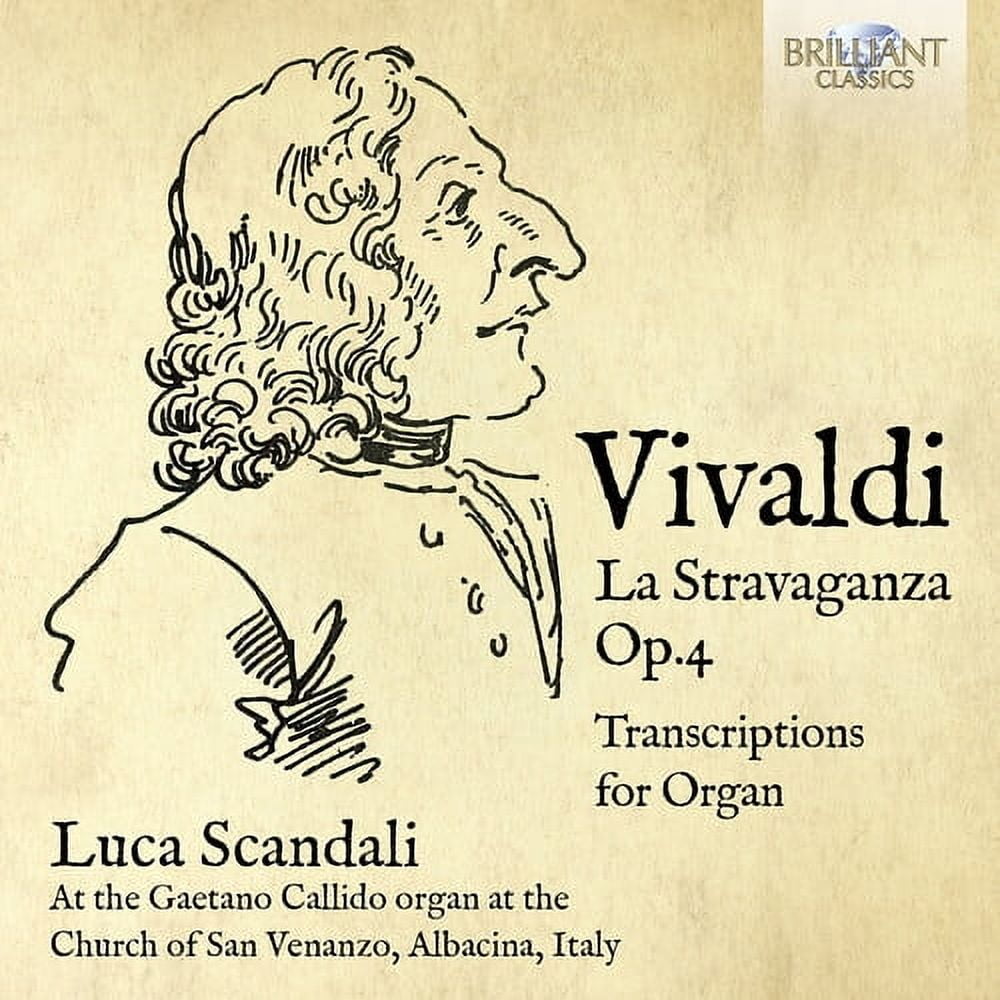
Luca Scandali - La Stravaganza, Op. 4 - Music & Performance - CD
Product details
| Management number | 254582778 | Release Date | 2026/11/07 | List Price | US$6.00 | Model Number | 254582778 | ||
|---|---|---|---|---|---|---|---|---|---|
| Category | |||||||||
The concerto played a leading role in the evolution of the language and style of instrumental music from the late 17th century onwards, with it's popularity and importance continuing to grow throughout the 18th century. Antonio Vivaldi (1678-1741) did not invent the concerto grosso or solo concerto, but he can, without a shadow of a doubt, be considered the composer who gave the greatest boost to the genre, turning it into the dominant form of instrumental music in the first half of the 18th century: without Vivaldi and his concertos, the history of music would surely have followed a different trajectory. La Stravaganza Op.4 was published in approximately 1714, and it's 12 concerti are almost entirely written for solo violin, with the sole exception of Concerto No.7, which is scored for two violins and cello. The curious title (which literally means 'extravagance' or 'eccentricity') that Vivaldi gave to this collection seems to refer to the early Italian baroque style, which remained dominant throughout the 1600s through to the early 1700s. This particular style sought to move and cajole audiences in various ways, including expert use of eccentric features, trickery and virtuosity, and it's influence was felt in all the 17th century's instrumental and vocal writing. Vivaldi's musical language and style also contained certain 'extravagant' elements, albeit interpreted in his own personal way. Numerous examples of stylistic originality marked a genuine departure from Corelli, while attesting to the bold experimentation and acrobatic virtuosity for which Vivaldi is renowned: asymmetry in form; extensive and inventive harmonic progressions; sudden, theatrical breaks; and prominent, fast and virtuosic solo parts. The concertos on this recording come from the Anne Dawson's Book collection, held in the Henry Watson Music Library in Manchester (UK). In addition to arias for voice and basso continuo, the collection, produced in around 1720, also contains a series of compositions for keyboard instruments and transcriptions of concertos by various composers, including ten by Vivaldi (three from Op.3 and seven from Op.4). The majority of the arrangements in this source are Italian concertos and serve to highlight in particular the huge popularity Vivaldi's concertos enjoyed. Like many transcriptions from the era, the arrangements in Anne Dawson's Book tend to prioritise the original score, while clearly adapting the pieces to the idiom of keyboard instruments and the opportunities they present. The anonymous arranger of Anne Dawson's Book aimed, and succeeded, to simplify the orchestral part in order to make it easier to perform at the keyboard without sacrificing anything of it's originality or rhythmic and harmonic variety. The concerto played a major role in the evolution of the style and language of instrumental music as early as the end of the 17th century, enjoying an increasing popularity and importance throughout the 18th century. Antonio Vivaldi (1678-1741), who was certainly not the inventor of the concerto grosso or the solo concerto, can without doubt be considered the composer who gave the greatest impetus to the genre, until it became the product par excellence of instrumental music around the first half of the 18th century: without Vivaldi and his concertos, the history of music would have taken different paths and orientations. Many concertos found their way to the audience through adaptations or transcriptions for harpsichord or organ. This CD presents Violin Concertos from Vivaldi's La Stravaganza Op. 4, transcribed for organ. These are contained in the collection known as Anne Dawson's Book and kept at the Henry Watson Music Library in Manchester (UK). The collection, compiled around 1720, contains, in addition to arias for voice and basso continuo, a number of compositions for keyboard instrument along with several transcriptions of concertos by various composers, including 10 by Vivaldi. They are closely related to the original score and show an evident process of adaptation to the possibilities and idiom of the keyboard instrument. Organist Luca Scandali is one of Italy's foremost scholars and keyboard players. For Brilliant Classics he recorded the complete organ works by C.P.E. Bach (nominated for the Preis der deutschen Schallplattenkritik), Galuppi, Pasquini, Pellegrini and Padovano. He plays the Gaetano Callido organ from 1774 at the Church of San Venanzo, Albacina, Italy.
- Luca Scandali - La Stravaganza, Op. 4 - Music & Performance - CD
- Music
- Brilliant Classics
- Classical
| Performer | Luca Scandali |
|---|---|
| Music genre | Classical |
| Media format | CD |
| Original release date | 2023 |
| Language | English |
| Is collectible | Y |
| Has parental advisory label | N |
| Number of discs | 1 |
| Series title | La Stravaganza |
| Track listing | Coming Soon! |
| Record label | Brilliant Classics |
| Composer | Antonio Vivaldi |
| Track name | Concerto No. 1 RV383a in B flat (Transposed in G), Concerto No. 3 RV301 in G (Transposed in F), Concerto No. 4 RV357 in A Minor, Concerto No. 5 RV347 in A (Transposed in F), Concerto No. 6 RV316a in D Minor, Concerto No. 10 RV 196 in C minor, Concerto No. 11 RV 204 in D (Transposed in C) |
| Digital audio file format | CD |
| Music media format | CD |
Bestseller ranking
Classical Composers
Correction of product information
If you notice any omissions or errors in the product information on this page, please use the correction request form below.
Correction Request Form